Coming to Kickstarter
Let an AI agent control real hardware.
BuggrBox is a bench instrument that gives an AI coding agent, or any script, physical control of an embedded prototype: power it, measure it, flash it, reset it, recover it. Hardware enforces the limits, so a runaway agent cannot override them.
Double opt-in. No spam, one-click unsubscribe. We email when the Kickstarter goes live.
> power.set dut=1 volts=3.7 limit_a=0.5> power.enable dut=1 on=true< ok armed 3.70V 0.0mA> usb.wait enumerated dut=1< ok port=/dev/ttyACM1# agent flashes app.bin with esptool> uart.open rx=0 tx=1 baud=115200> uart.wait match="boot ok"< ok "boot ok v0.4.2"> measure.current dut=1< ok 41.2mA< trip dut=1 overcurrent 812mA< rail latched off in hardware> power.rearm dut=1< ok off tripped=false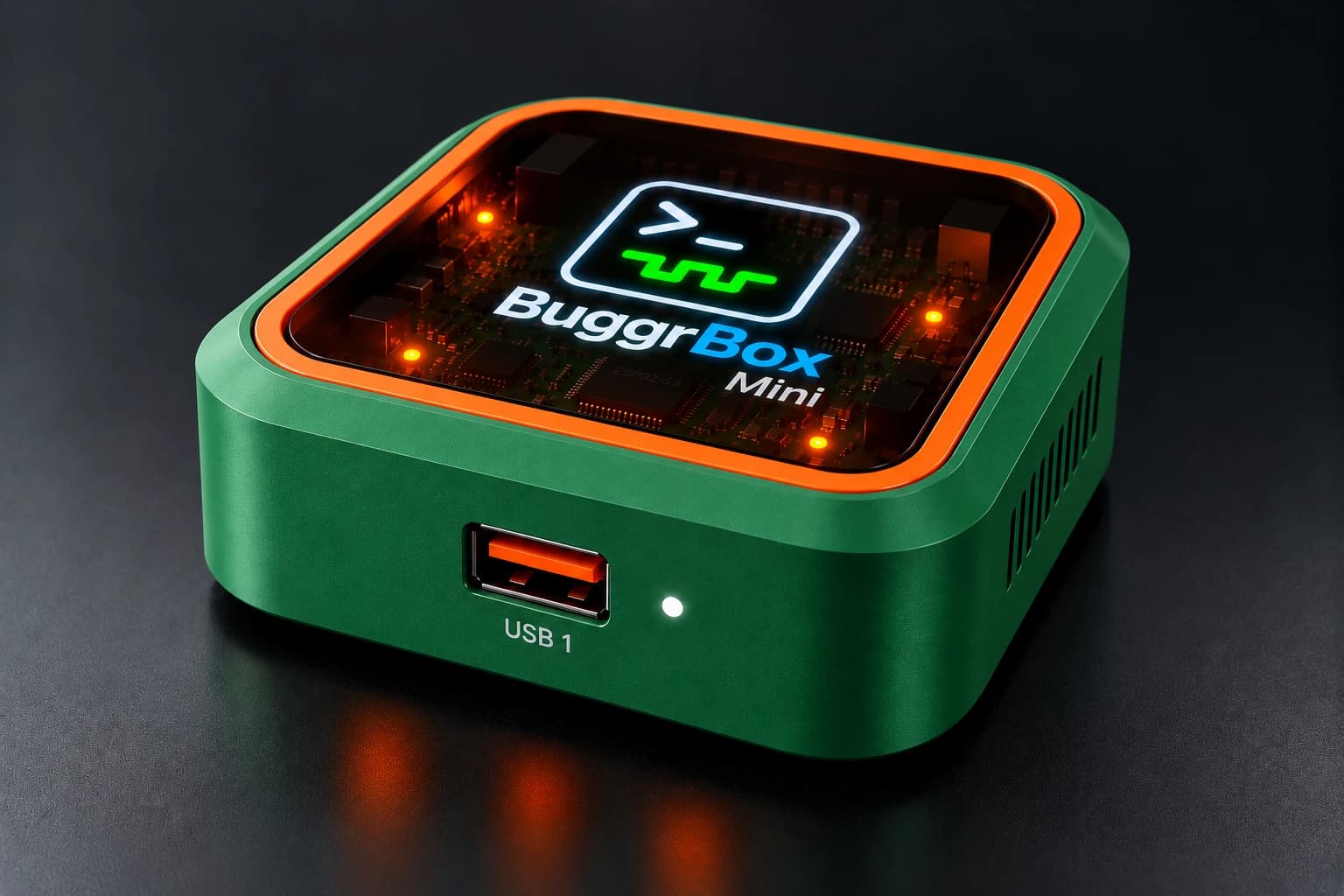
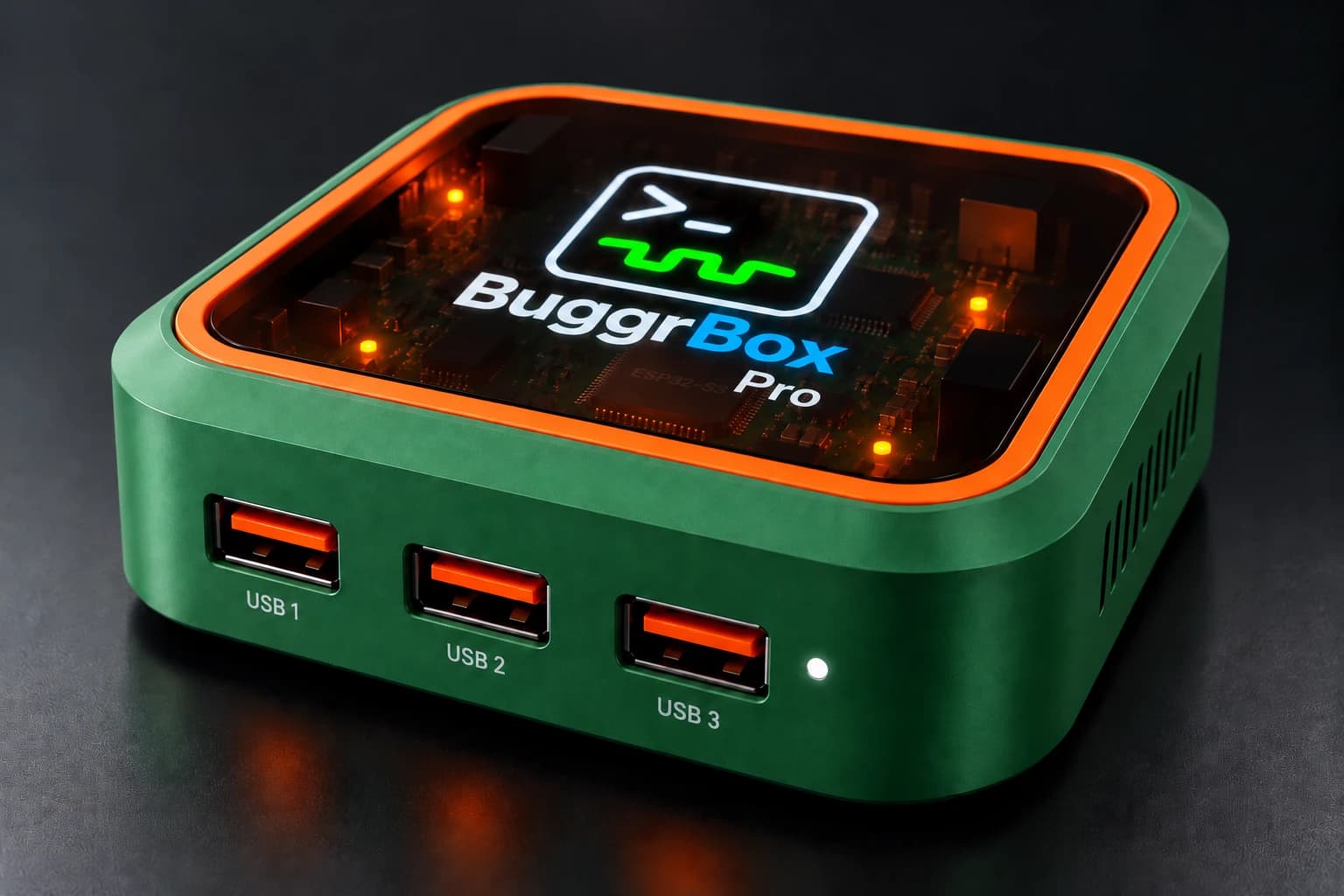
Concept renders, not final product photos.
How it works
Step 1
Wire it in
Connect BuggrBox to your machine over USB or Wi-Fi, then wire the prototype in: its supply from a DUT channel (VIN terminals plus a USB-A port), its signals on the shared GPIO, UART and I2C terminals. The GPIO are yours to assign: BOOT and RESET if the board has them, SWD, or plain pins.
Step 2
Point the agent at it
Every function is one JSON-RPC method. An AI coding agent and a plain script call them the same way: set a rail, read current, toggle a pin, put the DUT in download mode.
Step 3
Iterate on real hardware
The agent flashes, resets, reads the console and measures current in a loop. If the board pulls too much current or a rail sags, the hardware trips first and the agent sees the fault as data.
What it does
Programmable DUT power supply
VBUS (5 V) plus a programmable 1.0 to 4.2 V LiPo-simulator rail on every DUT channel, so firmware meets brown-out and battery-curve conditions on the bench.
Current measurement with a hardware trip latch
Live current measurement per channel, from deep-sleep microamps up. Silicon catches overcurrent and undervoltage, latches the rail off and reports the fault to the agent.
Analog inputs and thermocouples
Three ±30 V analog inputs (1 MΩ, 24-bit) for rails, sensor outputs and anything else on the board, plus a thermocouple input per DUT channel with cold-junction compensation and open-probe detection, so a soak or a brown-out sweep logs temperature next to current.
Eight GPIO at your board's logic level
Inputs and outputs from 1.2 to 5 V, shared by every channel and assigned however your board needs. If it has BOOT and RESET lines, wire them to any two and the UART bridge drives them the way esptool and avrdude expect. Otherwise they are plain pins for the agent to drive and read.
UART bridge and I2C
A UART bridge (RFC 2217 or raw) on any of the GPIO for consoles, boot logs and serial flashing, and a user I2C bus with stuck-bus recovery and a Qwiic port.
A 1 A load switch
One low-side PWM switch, 1 A, fed from a load-supply terminal (jumper it to a DUT rail or bring up to 15 V of your own) with a freewheel diode on the board, so the agent can switch or PWM a relay, motor, LED or heater, or drop a dummy load onto the DUT's rail from a script.
Switched USB on every DUT channel
The box disconnects, reconnects and power-cycles each DUT's USB port, so a bricked board comes back without touching a cable. Your PC still sees the board's own USB port, so esptool, OpenOCD, PlatformIO and vendor flashers work unchanged.
SWD debug probe built in
A CMSIS-DAP v2 probe on the same GPIO bank, at your board's logic level, so probe-rs, pyOCD and OpenOCD flash and debug Cortex-M targets through the box with no separate debugger on the bench. Over the USB link for now.
Hardware-enforced safety
Voltage ceilings, trip latches and a watchdog with no data link to the main processor. A runaway agent cannot raise the limits.
One JSON-RPC API over USB or Wi-Fi
The same protocol for an AI agent, a Python script or a plain HTTP request, so regression and hardware-in-the-loop tests run on real boards instead of simulators.
Who it's for
Firmware engineers using AI coding agents
Give the agent the loop it is missing: flash, reset, read the console, measure current, fix, repeat, without you at the bench.
Hardware teams automating bench tests
Programmable power, current measurement, USB switching and pin control from a script, for regression and hardware-in-the-loop tests on real boards.
Solo builders and small teams
One box instead of a bench supply, a USB switch, a serial adapter and "unplug it and plug it back in".
Mini or Pro
| Feature | Mini | Pro |
|---|---|---|
| DUT channels | 1 | 3 |
| Power rails per channel | VBUS 5 V + programmable 1.0 to 4.2 V | Same |
| Current measurement and trip latch | Per channel | Per channel |
| Thermocouple inputs | 1 | 3 |
| GPIO, UART, I2C, analog, load (shared by all channels) | 8 fast GPIO, 1 UART, 1 I2C bus + Qwiic, 3 analog inputs, 1 load switch | Same |
| Switched USB with pass-through to your PC | Per channel | Per channel |
| SWD debug probe (CMSIS-DAP v2, shared) | Yes | Yes |
| Host connection | USB or Wi-Fi | USB or Wi-Fi |
| Best for | One DUT at a time | A/B/C comparison and regression on three boards |
| Price | Announced at launch | Announced at launch |
FAQ
When does the campaign launch?
We're finishing prototype validation and user testing now. Sign up and you'll get the exact launch date by email before anyone else.
Does it work with Claude Code, Cursor or other AI coding agents?
Yes. BuggrBox comes with an MCP server whose tools are generated from the box's own method list, so Claude Code, Claude Desktop, Cursor and any other MCP client can drive it. Anything else that can send JSON-RPC over USB or Wi-Fi works too.
What stops an AI agent from frying my board?
Voltage ceilings, current trip latches and a watchdog live in hardware with no data link to the main processor. The agent sees when a limit trips, but it cannot raise the limit.
Which microcontrollers and dev boards does it support?
BuggrBox is not tied to one vendor. The DUT side is power rails, GPIO at your board's logic level, UART, I2C, SWD and USB, and your PC sees the DUT's own USB port through the box, so esptool, OpenOCD, PlatformIO, avrdude and vendor flashers work unchanged. Boards with BOOT and RESET lines get them driven from two GPIO: ESP32-style auto-reset, an Arduino-style reset pulse or direct control. Cortex-M boards can also be flashed and debugged over SWD through the built-in CMSIS-DAP probe.
Can I use it without an AI agent?
Yes. It is a scriptable bench instrument, and the agent is one client of the API. A Python script, a shell command or an HTTP request uses the same calls.
What is the difference between Mini and Pro?
Channel count and what comes with it. Mini has one DUT channel (rail, current sensing, USB port) and one thermocouple input; Pro has three of each, so it can work three boards at once. Same board, same firmware.
What will you email me?
The launch date, early-bird pricing when it's set, and the occasional build update. No newsletters, no third parties.
How do I unsubscribe?
Every email has a one-click unsubscribe link. We remove your address immediately.
Do I have to back the Kickstarter later?
No obligation. Signing up just means you hear first if you decide to back the campaign.
Hear first when it launches.
One email with the launch date and early-bird pricing, then the occasional build update.
Double opt-in. No spam, one-click unsubscribe. We email when the Kickstarter goes live.